Seeing a marble pound cake fresh out of the oven always feels like witnessing a little piece of edible art. The swirl of vanilla and chocolate is more than just visual; it’s a quiet dance of flavors that play off each other with every bite. I love how the pattern isn’t about precision but about embracing the imperfect, swirling chaos that makes each cake unique.
Baking this cake is a bit of a nostalgic ritual for me, reminding me of lazy weekends and the simple joy of mixing batter while the house fills with a warm, cocoa-scented air. There’s something satisfying about slicing through that marbled surface, revealing a beautiful, unexpected pattern. It’s a reassurance that even in baking, the beauty is in the unpredictability.
Focusing on the visual impact and subtle flavor interplay of marble pound cake, I see it as edible art. The swirl pattern isn’t just aesthetic; it’s a reminder of the chaos and beauty in baking, where each slice reveals a tiny surprise. This cake isn’t about perfection but about embracing the imperfect, swirling dance of vanilla and chocolate, making every slice feel like a personal discovery.
The art of swirling batter
- The swirl pattern feels like a little secret I get to reveal with each slice, almost like a hidden treasure.
- Baking this cake always sparks a sense of pride in how simple ingredients can come together to create something so visually stunning.
- There’s a nostalgic rush when I see the marbled batter ripple in the pan, reminding me of carefree afternoons baking with family.
- The faint scent of vanilla and cocoa wafts through the house, making everyone’s mood a bit lighter, even on tough days.
- I love how each slice feels like a tiny masterpiece—imperfect, chaotic, and perfectly mine.
The story behind this recipe
- Baking this marble pound cake always reminds me of my grandmother’s kitchen, where the air was thick with vanilla and cocoa. She’d swirl the batter with a gentle hand, creating those beautiful marbled patterns that felt like secrets shared between us. Now, every time I make it, I get a little nostalgic for those quiet afternoons and her steady, loving touch.
- The swirl technique isn’t just about looks; it’s an act of meditation, a moment to slow down and appreciate the beauty in chaos. I love how each slice reveals a tiny, imperfect masterpiece—proof that baking isn’t about perfection but about embracing the unpredictable artistry of batter and swirl.
- heading: The story behind this recipe
Marble Pound Cake Trivia
- This marble pound cake design originated in European bakeries in the early 20th century, aiming to combine visual elegance with rich flavor.
- The swirling technique was initially a way to use leftover batter creatively, turning what could be waste into a stunning pattern.
- In some regions, marble cakes are believed to bring good luck and prosperity, especially when shared during festive gatherings.
Ingredient breakdown
- Butter: I use unsalted butter for a rich, creamy base that melts into the batter—swap with margarine if you need a salt-free version, but it’ll lack that deep, dairy sweetness.
- Sugar: Granulated sugar brings a straightforward sweetness and tender crumb—consider coconut sugar for a hint of caramel, but it’ll darken the batter slightly.
- Flour: All-purpose flour is my go-to for structure—gluten-free blends work if you’re avoiding wheat, though the texture might be a tad denser.
- Cocoa powder: I prefer natural unsweetened for that intense, smoky chocolate hit—Dutch-processed will give a mellower, less acidic flavor, if that’s your vibe.
- Vanilla extract: The little splash of vanilla brightens everything—try almond extract for a different aromatic note, but keep it subtle to not overpower the swirl.
- Eggs: Large eggs bind and lift the batter—room temperature helps them incorporate smoothly, making the swirl more cohesive and glossy.
- Milk: Whole milk keeps the batter moist and tender—substitute with buttermilk for tang and extra softness, but reduce the sugar slightly to balance acidity.
Spotlight on key ingredients
Butter:
- I use unsalted butter for a rich, creamy base that melts into the batter—swap with margarine if you need a salt-free version, but it’ll lack that deep, dairy sweetness.
- Sugar: Granulated sugar brings a straightforward sweetness and tender crumb—consider coconut sugar for a hint of caramel, but it’ll darken the batter slightly.
- Flour: All-purpose flour is my go-to for structure—gluten-free blends work if you’re avoiding wheat, though the texture might be a tad denser.
Cocoa powder and Vanilla extract:
- Cocoa powder: I prefer natural unsweetened for that intense, smoky chocolate hit—Dutch-processed will give a mellower, less acidic flavor, if that’s your vibe.
- Vanilla extract: The little splash of vanilla brightens everything—try almond extract for a different aromatic note, but keep it subtle to not overpower the swirl.
Notes for ingredient swaps
- Butter: I use unsalted butter for a rich, creamy base that melts into the batter—swap with margarine if you need a salt-free version, but it’ll lack that deep, dairy sweetness.
- Sugar: Granulated sugar brings a straightforward sweetness and tender crumb—consider coconut sugar for a hint of caramel, but it’ll darken the batter slightly.
- Flour: All-purpose flour is my go-to for structure—gluten-free blends work if you’re avoiding wheat, though the texture might be a tad denser.
- Cocoa powder: I prefer natural unsweetened for that intense, smoky chocolate hit—Dutch-processed will give a mellower, less acidic flavor, if that’s your vibe.
- Vanilla extract: The little splash of vanilla brightens everything—try almond extract for a different aromatic note, but keep it subtle to not overpower the swirl.
- Eggs: Large eggs bind and lift the batter—room temperature helps them incorporate smoothly, making the swirl more cohesive and glossy.
- Milk: Whole milk keeps the batter moist and tender—substitute with buttermilk for tang and extra softness, but reduce the sugar slightly to balance acidity.
Equipment & Tools
- 9×5-inch loaf pan: Holds the batter during baking, shaping the cake.
- Electric mixer: Creams butter and sugar, and mixes the batter smoothly.
- Rubber spatula: Folds dry ingredients and helps create the marble swirl.
- Parchment paper: Prevents sticking and makes removal easier.
- Toothpick or skewer: Creates the marbled swirl by gently dragging through the batter.
Guided steps for marble pound cake
- Preheat your oven to 175°C (350°F). Grease a 9×5-inch loaf pan and line it with parchment paper for easy release.
- In a large bowl, beat 1 cup (226g) unsalted butter and 1 1/2 cups (300g) sugar until pale and fluffy, about 3-4 minutes. Use a mixer on medium speed.
- Add 4 large eggs, one at a time, beating well after each addition. Make sure each egg is fully incorporated before adding the next. Scrape down the sides of the bowl.
- In a separate bowl, whisk together 2 1/2 cups (310g) all-purpose flour, 1 teaspoon baking powder, and a pinch of salt. Gradually add dry ingredients to the butter mixture, alternating with 1/4 cup (60ml) milk, starting and ending with dry ingredients. Mix just until combined.
- Divide the batter evenly into two bowls. To one, add 1/4 cup (25g) unsweetened cocoa powder and fold until smooth, creating a chocolate batter. Keep the plain vanilla batter in the other.
- Drop spoonfuls of vanilla and chocolate batter into the prepared pan, alternating and slightly overlapping. Use a skewer or a knife to swirl gently through the batter, creating a marbled pattern. Don’t overmix; the goal is a gentle swirl.
- Bake for 55-65 minutes. Check for doneness by inserting a toothpick into the center—if it comes out clean, the cake is ready. The top should be golden and slightly cracked.
- Remove from oven and let the cake cool in the pan for 15 minutes. Then, transfer to a wire rack and let it cool completely before slicing.
Let the cake cool completely in the pan on a wire rack. Once cooled, slice carefully with a serrated knife. Serve as is or dust lightly with powdered sugar for an elegant touch.
How to Know It’s Done
- Golden crust with a slight crack on top, indicating proper baking.
- Toothpick inserted in the center comes out clean, without wet batter.
- The cake feels firm but springy to the touch, not overly dense or shaggy.
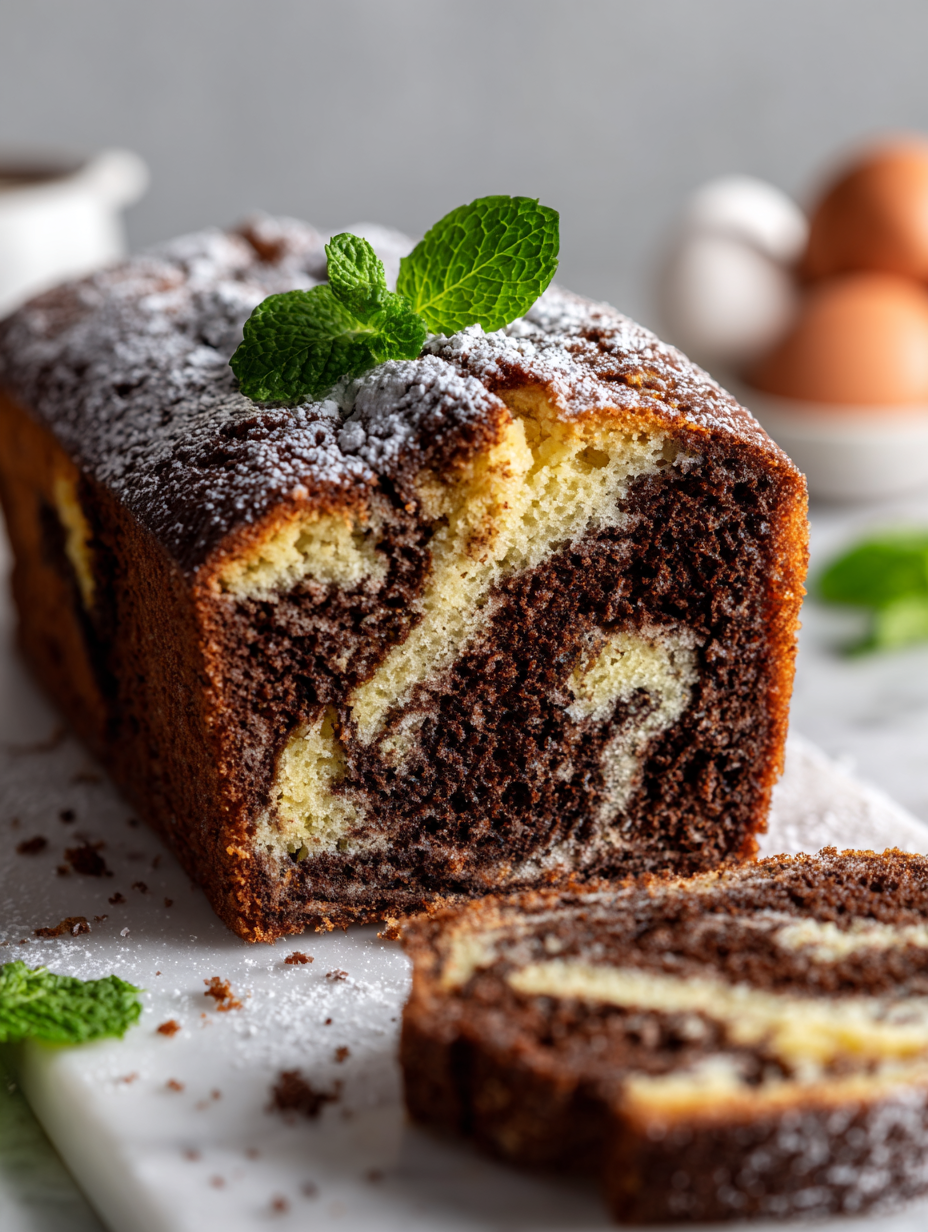
Marble Pound Cake
Ingredients
Equipment
Method
- Preheat your oven to 175°C (350°F). Grease your loaf pan and line it with parchment paper for easy removal.
- In a large bowl, beat the softened butter and sugar together with an electric mixer until the mixture is light, fluffy, and pale in color, about 3-4 minutes. This creates a creamy base for your batter.
- Add the eggs one at a time, beating well after each addition to ensure they are fully incorporated. The batter should become smooth and glossy, with a slight sheen. Scrape down the sides of the bowl as needed.
- In a separate bowl, whisk together the sifted flour, baking powder, and a pinch of salt. Gradually add the dry ingredients to the wet mixture, alternating with the milk, beginning and ending with the dry ingredients. Mix just until combined, being careful not to overmix.
- Divide the batter evenly into two bowls. To one, add the cocoa powder and gently fold until fully incorporated, creating a rich chocolate batter. Keep the other as vanilla.
- Spoon alternating dollops of vanilla and chocolate batter into the prepared loaf pan. Be generous and aim for a layered effect, but don’t smooth it out yet.
- Use a toothpick or skewer to gently swirl through the batter, creating a marbled pattern. Drag lightly from top to bottom and side to side, but avoid overmixing to keep the swirl distinct.
- Bake in the preheated oven for about 55 to 65 minutes. Check for doneness by inserting a toothpick into the center; if it comes out clean, the cake is ready. The top should be golden and slightly cracked.
- Allow the cake to cool in the pan for about 15 minutes. Then, transfer it to a wire rack and let it cool completely before slicing to reveal the beautiful marbled pattern.
- Slice the cake with a serrated knife to showcase the swirl. Serve as is or dust lightly with powdered sugar for an elegant finish. Enjoy the moist, dense texture with its stunning visual appeal!
Tips for perfect marble pound cake
- Bolded Tip: Use room temperature eggs to ensure a smooth, cohesive batter that swirls easily.
- Bolded Tip: Gently fold the cocoa into half the batter to prevent deflating the whipped butter mixture.
- Bolded Tip: Drop spoonfuls of vanilla and chocolate batter alternately for a more natural, less uniform swirl.
- Bolded Tip: Use a skewer or thin knife to lightly drag through the batter, creating a marbled effect without overmixing.
- Bolded Tip: Bake until the top is golden and a toothpick inserted in the center comes out clean, about 55-65 minutes.
- Bolded Tip: Cool the cake in the pan for at least 15 minutes before transferring to a wire rack to prevent breaking.
- Bolded Tip: Wrap cooled cake tightly and store at room temperature for up to 2 days or freeze for longer storage.
Common marble cake mistakes and solutions
- FORGOT to check oven temperature → Use an oven thermometer for accuracy.
- DUMPED batter into pan too quickly → Pour slowly to avoid streaks and uneven swirl.
- OVER-TORCHED the top → Cover with foil halfway through baking if browning too fast.
- MISSED the swirl step → Gently drag a skewer through batter for a marbled effect.
Quick Fixes for Marble Pound Cake
- If batter is too thick, splash in a little milk to loosen it.
- When swirl pattern is muddy, gently drag a skewer again to refine.
- Splash with vanilla extract if aroma is faint before baking.
- Patch cracks with a tiny amount of batter if the top splits during baking.
- Shield the cake with foil if edges brown too quickly, preserving moisture.
Prep, store, and reheat tips
- Prepare the batter and swirl it in the pan a day ahead; cover tightly and refrigerate for up to 24 hours. The flavors meld slightly, and the swirl stays defined.
- Bake the cake a day in advance to allow flavors to develop fully. Store wrapped in plastic at room temperature for up to 2 days or in the fridge for 4 days. Reheat in a 150°C (300°F) oven for about 10 minutes until warm and fragrant.
- Slice only when ready to serve to prevent drying out. Store sliced cake wrapped in plastic in the fridge for up to 2 days, and rewarm slices gently in the oven for a softer bite.
- Refrigeration enhances the moist, tender crumb but can dull the visual contrast of the swirl. Let it come to room temp for best flavor before serving.
- For longer storage, tightly wrap and freeze for up to 3 months. Thaw at room temp or in the oven, watching for a gentle shimmer of heat to revive moisture.
Top questions about marble pound cake
1. What exactly is a marble pound cake?
A marble pound cake is a dense, buttery loaf with swirls of vanilla and chocolate, offering a beautiful visual and a rich flavor combo.
2. How do I get the perfect swirl pattern?
Use room temperature eggs and butter for a smooth batter that swirls easily without streaks.
3. How do I know when the cake is done?
Bake until the top is golden, a toothpick comes out clean, and it feels springy but not jiggly.
4. Can I make this cake gluten-free?
You can substitute with gluten-free flour, but the texture might be a bit denser and less tender.
5. Can I use a different fat than butter?
Yes, you can swap butter for margarine or coconut oil, but it may affect the richness and moisture.
6. How should I store leftovers?
Wrap the cooled cake tightly and store at room temperature for up to 2 days, or freeze for longer.
7. My swirl pattern looks messy, what can I do?
If the swirl is muddy, gently drag a skewer again through the batter for a cleaner pattern.
8. What if the cake cracks too much?
When the top cracks excessively, cover with foil halfway through baking to prevent burning.
9. How deep should I swirl the batter?
Use a toothpick or skewer to gently drag through the batter, just enough to create a marbled effect.
10. How do I reheat leftover slices?
Reheat slices in a warm oven at 150°C (300°F) for about 10 minutes for best freshness.
Baking this marble pound cake feels like creating a small piece of art that’s also comfort food. The aroma of vanilla and cocoa drifting through the house as it cools is pure, simple joy. Sharing the slices, each with its unpredictable swirl, reminds me that beauty often lies in the imperfect and the spontaneous.
In a world that values perfection, this cake offers a gentle reminder to embrace the chaotic, swirl and all. It’s a treat that feels like a quiet celebration of craft, nostalgia, and the sweet chaos of life. A slice or two is a perfect pause in any day.

Hi, I’m Noah Bennett, the creator behind Breathing In Flavors. For me, cooking begins with a breath. Before the first bite, before the plating, before the garnish, there is that quiet moment when steam rises and you inhale. That is where flavor truly begins. Breathing In Flavors is my space to slow down, appreciate ingredients, and cook with awareness. I am so glad you’re here.
 The creator behind Breathing In Flavors.
For me, cooking begins with a breath. Before the first bite, before the plating, before the garnish, there is that quiet moment when steam rises and you inhale. That is where flavor truly begins.
Breathing In Flavors is my space to slow down, appreciate ingredients, and cook with awareness. I am so glad you’re here.
The creator behind Breathing In Flavors.
For me, cooking begins with a breath. Before the first bite, before the plating, before the garnish, there is that quiet moment when steam rises and you inhale. That is where flavor truly begins.
Breathing In Flavors is my space to slow down, appreciate ingredients, and cook with awareness. I am so glad you’re here.